English
Single Sided vs Double Sided Cantilever Rack: Pros, Cons & When to Use Each
Read More

Search
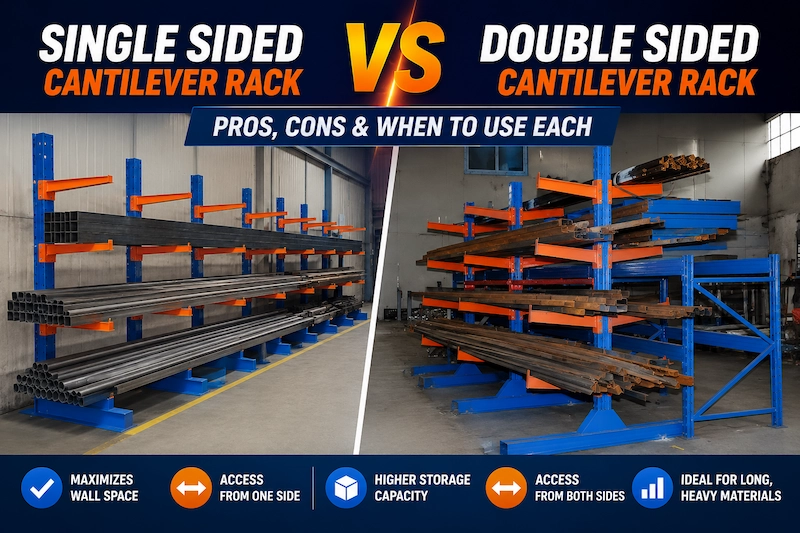
Cantilever racking is one of the most effective storage solutions for long, bulky, and irregularly shaped materials. Whether you store lumber, steel pipes, aluminum profiles, furniture boards, plastic tubing, or construction materials, choosing between a single sided and double sided cantilever rack can significantly impact storage capacity, accessibility, warehouse layout, and overall return on investment.
In most cases, single sided cantilever racks are ideal when the rack must be positioned against a wall, while double sided cantilever racking provides maximum storage density when installed in open warehouse areas.
A cantilever rack consists of vertical columns, horizontal arms, and a stable base. Unlike conventional pallet racking, there are no front uprights blocking access to stored materials.
This open-front design allows operators to easily store and retrieve long products using forklifts, side loaders, or manual handling equipment.
Industries commonly using cantilever racks include:
Steel service centers
Timber and lumber yards
Furniture manufacturers
Building material suppliers
Pipe and tube distributors
Aluminum profile manufacturers
A single sided cantilever rack has storage arms extending from only one side of the upright column.
The opposite side remains flat or is anchored toward a wall.
Wall-mounted storage areas
Narrow warehouses
Small storage facilities
Workshops with limited floor space
Outdoor perimeter storage
One column line
Arms on one side only
Single loading direction
Lower footprint requirement
A double sided cantilever rack features storage arms extending from both sides of the upright column.
The central column serves two storage faces simultaneously.
This design effectively doubles storage capacity compared with a comparable single sided configuration occupying the same rack length.
Large warehouses
Distribution centers
Steel storage facilities
Lumber yards
Industrial manufacturing plants
Central upright column
Storage arms on both sides
Dual loading access
Higher storage density
| Factor | Single Sided Cantilever Rack | Double Sided Cantilever Rack |
|---|---|---|
| Storage Capacity | Moderate | High |
| Warehouse Space Efficiency | Good | Excellent |
| Wall Installation | Ideal | Not Suitable |
| Accessibility | One Side | Two Sides |
| Material Usage | Lower | Higher |
| Investment Cost | Lower | Higher |
| Storage Density | Lower | Higher |
| Expansion Potential | Good | Excellent |
Single sided systems maximize otherwise unused wall space and keep warehouse aisles open.
Because arms are installed on only one side, steel consumption is lower, reducing equipment costs.
The structure is generally easier to install and configure.
Warehouses with limited floor area often benefit from single sided layouts.
Only one storage face is available, limiting capacity.
In large warehouses, single sided racks may not fully utilize available space.
Future growth may require additional rack rows.
Double sided cantilever racking creates two storage faces using a single column line, increasing storage efficiency.
Warehouses with large open layouts often achieve significantly more storage capacity.
Different materials can be stored on opposite sides of the same rack row.
Forklifts can access inventory from both sides, improving workflow flexibility.
Additional arms and heavier structural components increase initial investment.
The rack must be positioned away from walls to allow access from both sides.
Aisle planning becomes more important to ensure efficient forklift movement.
Small fabrication workshops
Local building material suppliers
Automotive repair facilities
Furniture workshops
Maintenance departments
These businesses often prioritize flexibility and lower investment over maximum storage density.
Steel processing centers
Pipe distributors
Large lumber yards
Industrial manufacturers
Logistics warehouses
Construction material wholesalers
These operations typically manage large inventory volumes and benefit from higher storage capacity.
If racks will be installed against a wall, single sided systems are generally the logical choice.
If racks will be located in open warehouse areas, double sided systems usually provide greater efficiency.
Higher inventory levels often justify the investment in double sided cantilever racking.
Longer and heavier materials may require larger arm capacities and stronger structural components regardless of rack configuration.
Warehouse traffic flow should support safe loading and unloading operations.
Businesses expecting growth should design layouts that allow additional rack rows and longer rack runs.
| Cost Factor | Single Sided | Double Sided |
|---|---|---|
| Equipment Cost | Lower | Higher |
| Installation Cost | Lower | Moderate |
| Storage Capacity per Rack Row | Lower | Higher |
| Long-Term Space Efficiency | Moderate | Excellent |
Although double sided systems require higher upfront investment, many warehouses achieve a lower storage cost per ton of inventory over time due to improved space utilization.
No. It depends on warehouse layout, available space, inventory volume, and operational requirements.
Yes. Properly engineered single sided cantilever racks can safely store heavy steel, timber, and industrial materials.
No. Doing so would block access to one side and eliminate the primary advantage of the system.
Double sided cantilever racking generally offers significantly higher storage density and better utilization of open warehouse space.
If your storage system will be positioned along walls or within a compact warehouse, a single sided cantilever rack offers a practical and cost-effective solution. If you operate a larger facility with substantial inventory volumes and open floor space, double sided cantilever racking usually delivers superior storage density, better operational efficiency, and stronger long-term value.
Before purchasing, evaluate inventory characteristics, handling equipment, warehouse dimensions, future growth plans, and loading requirements. The best cantilever rack system is the one that balances capacity, accessibility, safety, and return on investment for your specific operation.