English
Single Sided vs Double Sided Cantilever Rack: Pros, Cons & When to Use Each
Read More

Search
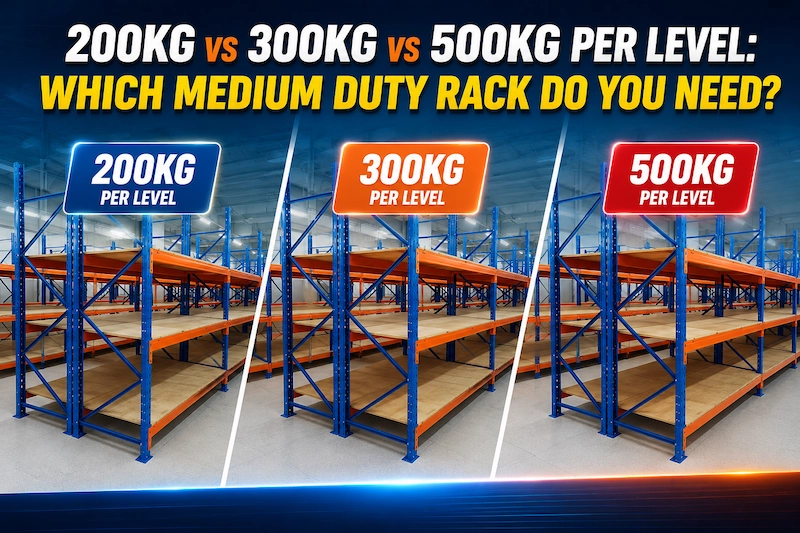
Choosing the right medium duty steel rack is not only about how much weight one shelf can hold. It also affects warehouse safety, picking efficiency, storage cost, future expansion, and how long the rack system can serve your operation.
For light cartons, tools, spare parts, and retail inventory, a 200kg per level rack may be enough. For mixed warehouse storage, 300kg per level is usually the most flexible choice. For heavier cartons, industrial parts, molds, hardware, and dense products, 500kg per level offers better safety margin and long-term durability.
The load capacity refers to the maximum evenly distributed weight that one shelf level can safely support under proper installation conditions.
This means the weight should be spread across the beam and panel area, not concentrated in one small point. A shelf rated for 300kg may not perform safely if a 300kg machine part is placed only in the center of a thin panel.
| Load Capacity | Best For | Typical Products | Main Advantage | Buyer Consideration |
|---|---|---|---|---|
| 200kg per level | Light to medium storage | Cartons, small tools, packaged goods, documents | Lower cost and easy handling | Not suitable for dense or oversized goods |
| 300kg per level | General warehouse storage | Spare parts, retail stock, small machinery parts, electronics | Balanced cost and strength | Requires proper beam and upright selection |
| 500kg per level | Heavy medium-duty storage | Hardware, molds, motors, metal parts, industrial components | Higher safety margin and durability | Higher initial investment |
A 200kg rack is suitable for warehouses storing lightweight cartons, packaging materials, clothing, accessories, stationery, documents, or small consumer products.
Retail businesses often choose 200kg racks because they are economical, easy to assemble, and flexible enough for changing stock types.
If your products are not heavy and your warehouse does not require high load capacity, 200kg shelving helps control initial investment.
A 200kg rack may not be suitable if your inventory includes liquids, metal parts, machinery components, batteries, tiles, hardware, or dense packed cartons. These products can quickly exceed the real working load of the shelf.
A 300kg medium duty steel rack is often the most practical option for businesses with different product sizes and weights. It gives more flexibility than 200kg racks while still keeping costs reasonable.
Many e-commerce warehouses store a mix of cartons, individual products, spare parts, and packaged goods. A 300kg rack provides enough strength for daily picking and replenishment operations.
If your inventory may become heavier in the future, choosing 300kg instead of 200kg can reduce the risk of early replacement.
For many buyers, 300kg per level provides the best balance between price, strength, installation convenience, and long-term usability.
A 500kg rack is better for metal components, auto parts, motors, bearings, molds, tools, electrical equipment, and other dense products.
If staff frequently load and remove heavy goods, a stronger rack structure helps reduce deformation, shaking, and long-term fatigue.
Factories and heavy-duty warehouses often prefer 500kg racks because they provide better durability under repeated loading.
If your goods are light and your storage needs are simple, choosing 500kg may increase cost without adding real operational value.
Do not calculate based only on average weight. Always consider the heaviest possible loading condition.
A practical approach is to leave 20% to 30% extra capacity. For example, if your actual goods weigh around 220kg per level, a 300kg rack is safer than a 200kg rack.
Evenly distributed cartons are easier to support than concentrated heavy objects. For point loads, stronger panels or additional support bars may be needed.
If product weight may increase, choose a stronger rack from the beginning rather than replacing the whole system later.
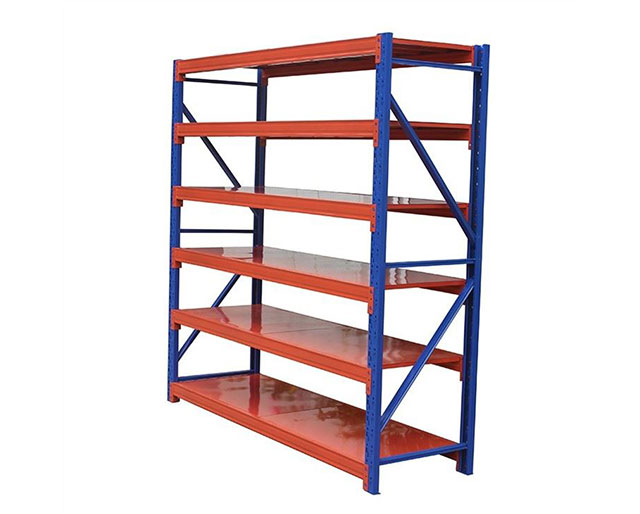
Load capacity is not determined by one number alone. A reliable medium duty steel rack depends on the complete structure.
Upright thickness
Beam profile and beam thickness
Layer board material
Number of support bars
Frame depth and height
Connection design
Floor levelness
Installation quality
A cheaper rack may use thinner steel, weaker beams, or lower-quality coating. This can lead to bending, instability, and shorter service life.
Some buyers estimate weight by carton size, but small products such as metal fittings, screws, and electronic components can be much heavier than expected.
A rack that is strong enough but poorly arranged can still reduce warehouse efficiency.
If the warehouse layout may expand later, choose rack dimensions and specifications that can be repeated or extended.
| Your Storage Situation | Recommended Capacity | Reason |
|---|---|---|
| Light cartons and retail goods | 200kg per level | Cost-effective and sufficient for light storage |
| Mixed warehouse inventory | 300kg per level | Balanced strength and price |
| Spare parts and heavier cartons | 300kg or 500kg per level | Depends on actual weight and handling frequency |
| Metal parts, molds, motors, hardware | 500kg per level | Higher load capacity and better safety margin |
| Future inventory is uncertain | 300kg per level or above | More flexible for long-term use |
Yes, if your products are light cartons, retail stock, documents, or small packaged goods. For dense or heavy items, 300kg or 500kg is safer.
For many general warehouses, yes. It offers a good balance between cost, strength, and flexibility.
Not always. A 500kg medium duty rack is still mainly designed for manual or semi-manual storage, while pallet racking is designed for palletized goods and forklift operation.
Usually yes, especially if your load weight is close to the rated capacity. A reasonable safety margin helps improve durability and reduce operational risk.
Choose 200kg per level if your goods are light and cost control is the priority. Choose 300kg per level if you need a flexible medium duty steel rack for mixed warehouse storage. Choose 500kg per level if your products are heavy, dense, or frequently handled in industrial environments.
Before purchasing, confirm product weight, shelf size, loading method, warehouse layout, and future expansion needs. The right rack is not simply the strongest one. It is the system that matches your actual storage operation with the best balance of safety, efficiency, and long-term value.